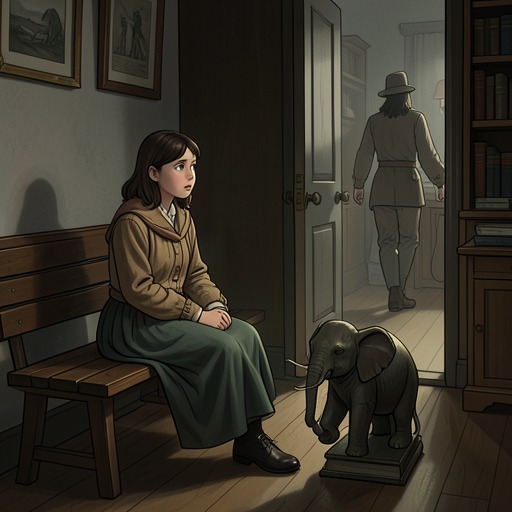
“You must simply knock”
The Magician's Elephant“You must simply knock” is Sister Marie’s repeated assurance that the orphanage door is unlocked and that those who need entry need only ask. Its literal simplicity gives it force: first it welcomes Adele, who is already inside, and later it accompanies the arrival of the elephant at the open door. Across those scenes, the phrase turns a rule about access into an image of welcome offered before a visitor’s needs can be fully understood.
The Saying and Its Setting
At the orphanage’s front door, Sister Marie gives the instruction in two forms. When Adele wakes from a dream of the elephant knocking again and again without an answer, she goes downstairs and finds Sister Marie asleep in her chair. Startled, Sister Marie cries, “But the door is unlocked! The door is forever unlocked. You must simply knock!” The words sound like a standing rule, but their emphasis is less on keeping order than on making entry possible.
Adele replies, “I am inside already.” The small exchange gently exposes the mismatch between Sister Marie’s formula and the immediate situation: Adele has not come to the door as a stranger seeking admission but has crossed the threshold before Sister Marie has fully awakened. Sister Marie recognizes her and notes that she should be in bed, but the moment is not treated as a refusal or reprimand. The instruction’s welcome remains intact even when it is not needed literally.
Adele and the Open Door
The saying follows Adele’s distressing dream. She has seen the elephant knocking and no one answering; unable to settle herself by calling it only a dream, she leaves her bed and seeks the familiar presence of Sister Marie at the front door. The repeated knock in the dream makes the unlocked-door rule emotionally charged: an open entrance matters little if no one responds to the person outside. Sister Marie’s words answer that fear with both a practical assurance and her presence at the threshold.
Later, when Adele asks what she was like on arrival, Sister Marie remembers that Adele was only a few hours old. In this conversation, the rule acquires a history of care: Sister Marie says that she understands how to open a door and that she did so for Adele. Her response does not claim to understand everything about Adele; it locates welcome in an action she could take. The phrase’s simplicity is therefore matched by a concrete act of admission.
The Phrase Returns
The saying recurs when a draft from the open door wakes Sister Marie. She again cries, “The door is unlocked! The door is always and for ever unlocked. You must simply knock.” Once fully awake, she sees that the door is wide open and that snow is falling in the darkness beyond it. Outside, in the street, stands an elephant.
The repetition changes the saying’s immediate force. In Adele’s earlier scene, Sister Marie speaks before she knows why Adele has come downstairs; here she speaks as the door is already open and the extraordinary visitor is visible beyond it. The instruction is no longer only a general promise of access. It converges with the elephant’s presence at the orphanage threshold, linking Adele’s remembered dream of unanswered knocking to a real arrival. Sister Marie rises to close the door, but first she sees the elephant there.
Hospitality and Its Consequences
The line’s recurring importance lies in the difference between admission as a rule and welcome as a response. The orphanage door is said to be unlocked, yet the scenes also depend on someone being present to answer: Sister Marie wakes to Adele, and later wakes to the open door and the elephant. The phrase thus holds open the possibility of connection without guaranteeing that every visitor’s need will be understood in advance.
That emphasis resonates with other acts of care in the story. A fortune-teller charges Peter Augustus Duchene a florit for an answer, while Leo Matienne gives a coin to a beggar who has turned his words into a song, and Gloria Matienne places stew in Peter’s hands when he arrives hungry. These scenes are distinct from Sister Marie’s doorway rule, but together they contrast exchange governed by a price with gestures that create room for trust and care. “You must simply knock” gives that welcome its most concise form: entry begins with an appeal, and someone on the other side may choose to open.